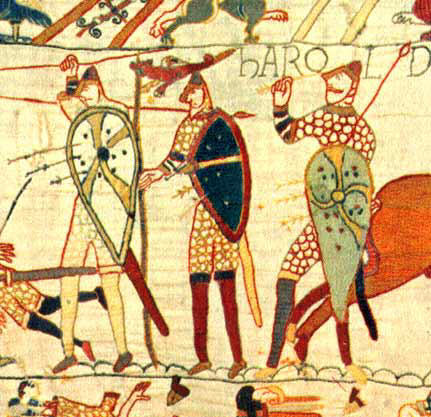
After the Battle of Hastings in 1066, which resulted in the successful Norman conquest of England, William the Conqueror's wife, along with her many ladies in waiting, began working on a tapestry. The tapestry was designed to tell the story of her husband's successful invasion of England.
There were 72 scenes. Each scene told one piece of the story. William's wife and her ladies worked on the tapestry for 10 years. When they were done, the tapestry was 20 inches high, and 250 feet long. The scenes were quite lively. In one, men are standing in a boat, holding their hands up to their mouths, as if they are shouting.
Historians can tell a lot about daily life from the scenes on the Bayeux Tapestry. The tapestry has boats, people, activities, carts, horses, and so much more. All you can see in one scene is a group of horse heads sticking out of the top of a boat. But from this, historians can guess that horses were carried by boats to the battle.
During medieval times, tapestries were common. They were used to decorate castles and manor houses. This tapestry was probably made to fit in a specific place. The wall upon which it hung was probably right around 250 feet long.
